Scaling a service-based business to eight figures is often more challenging than scaling an e-commerce or product-based business. Brands like Secretlab, Love, Bonito, and Razer have demonstrated how quickly product-based businesses can grow. However, achieving similar growth in service-based industries is often more difficult.
Whether you run a digital marketing agency, interior design firm, law firm, salon, or tuition center, scaling your business requires more than hiring additional employees or generating more leads.
So, what is stopping service-based businesses from growing faster? And how can you overcome these challenges to build a scalable business?
The answer starts with understanding your numbers.
Why Service-Based Businesses Struggle to Scale
Many business owners believe that scaling a service-based business is difficult because it is manpower-intensive. Unlike selling physical products, providing professional services often requires people, expertise, and time.
As the business grows, you may need to hire more employees, find qualified talent, and train your team to deliver consistent results.
While these challenges are real, they are not necessarily the biggest obstacle to scaling.
One of the main reasons service-based businesses struggle to scale is that they don’t know their numbers.
Many service businesses approach marketing cautiously. They may maintain an advertising budget of around $3,000 per month for years because they are uncertain about the returns.
E-commerce businesses, on the other hand, are often more aggressive in increasing their advertising budgets. They want to scale their campaigns to $10,000, $30,000, or even $50,000 per month as quickly as possible.
The difference is not necessarily that e-commerce entrepreneurs are more ambitious or have more money. It is often because they can see how their advertising investment translates into revenue.
Why E-Commerce Businesses Scale Faster
E-commerce businesses generally have shorter sales cycles. A customer clicks on a Facebook ad, visits an online store, and makes a purchase. The transaction can happen within minutes, allowing the business to track sales more directly.
For example, if an e-commerce business spends $10,000 on advertising and generates $30,000 to $50,000 in revenue, it has a clear reason to consider increasing its budget, provided the campaign is profitable.
This creates a potential growth cycle: advertising generates sales, revenue supports reinvestment, and reinvestment drives further growth.
Savvy business owners understand that money can be used to generate more money rather than being spent without a clear purpose.
Service-based businesses face a different situation. They may spend $3,000 on advertising but wait three months or longer before seeing the resulting revenue.
Instead of immediately generating sales, their advertising typically generates leads. Those leads must go through several stages before becoming paying customers.
As a result, service-based businesses often view advertising as a cost center rather than a profit center.
When e-commerce businesses spend $10,000 on ads, they may be buying sales. When service businesses spend $10,000, they are often buying leads, with no guarantee that those leads will convert.
This uncertainty prevents many service businesses from increasing their budgets, leaving significant growth opportunities untapped.
The goal isn’t to suggest that every business should move into e-commerce. E-commerce has its own challenges. Instead, service-based businesses can learn from its data-driven approach to marketing.
Understand Your Sales Funnel and Know What Every Lead Is Worth
To scale effectively, service-based businesses need to track how leads move through their sales funnel.
There are three important conversion stages:
- Leads to appointments: How many enquiries turn into booked appointments?
- Appointments to show-ups: How many prospects actually attend their scheduled meetings?
- Show-ups to closed deals: How many attended sales meetings result in paying customers?
Without tracking these stages, you may know how many leads your campaign generates but have no idea how much revenue those leads actually produce.
Let’s look at an example.
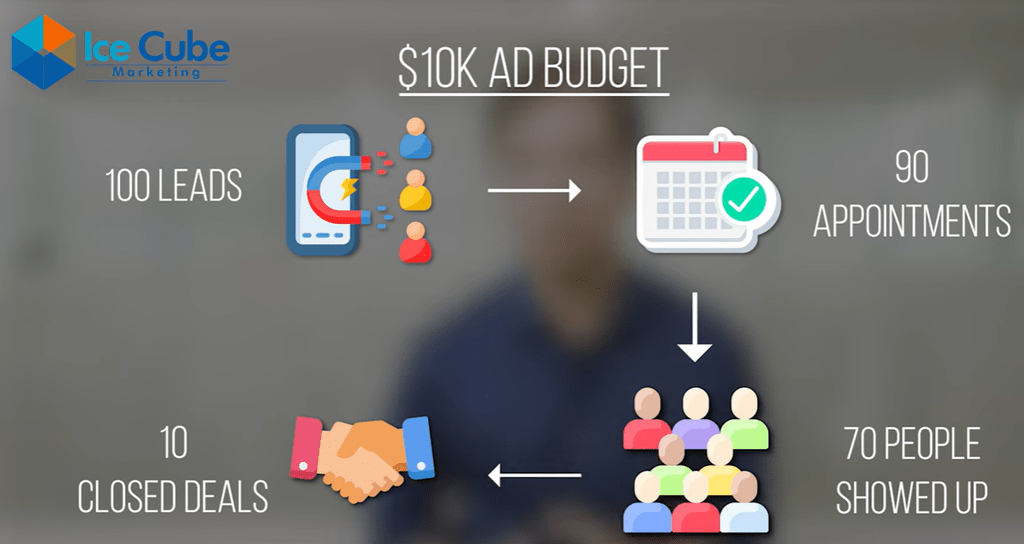
Suppose your business spends $10,000 on advertising and generates 100 leads.
- 100 leads are generated.
- 90 leads book appointments.
- 70 prospects show up for their meetings.
- 10 deals are closed.
- Each customer purchases a $2,000 package.
This results in $20,000 in revenue from a $10,000 advertising investment.
However, this is revenue, not profit. You still need to consider service delivery costs, salaries, overhead, and other business expenses.
The value of this example is that it shows how historical conversion data can help you evaluate your marketing investment.
Calculate the Value of Your Leads
Once you understand your sales funnel, you can work backward to estimate the value of each lead.
In this example, 10 customers are acquired from 100 leads, giving the business a 10% lead-to-customer conversion rate.
If each customer generates $2,000 in revenue:
$2,000 × 10% = $200
This means each lead is worth an estimated $200 in revenue, based on the historical results.
Now, let’s look at the other stages.
Of the 70 prospects who attended their meetings, 10 became customers. That gives an approximate closing rate of 14.3%, or around 15%.
Using the rounded 15% closing rate:
$2,000 × 15% = $300
Each attended sales meeting is worth approximately $300 in expected revenue.
For booked appointments, 70 out of 90 prospects showed up, giving a show-up rate of approximately 77.8%.
Based on the actual funnel numbers, each booked appointment is worth approximately $222 in expected revenue.
These figures help business owners understand the financial value of leads, appointments, and sales meetings.
Use Cost Per Lead as a Leading Indicator
You don’t always have to wait for revenue to come in before deciding whether to scale your advertising campaign.
If each lead generates an estimated $200 in revenue, you can use cost per lead (CPL) as an early performance indicator.
For example, spending $10,000 to generate 100 leads means your CPL is $100.
At $100 per lead, you are acquiring leads at half their estimated revenue value of $200.
This may indicate an opportunity to scale your campaign, assuming your lead quality and conversion rates remain consistent.
However, the $200 lead value is based on expected revenue, not profit. Your acceptable CPL must also account for fulfillment costs, operating expenses, cash flow, and your desired profit margin.
As advertising spending increases, conversion rates and lead quality may also change. Therefore, scaling should be gradual and supported by reliable data.
The advantage of using historical numbers is that you can make more informed decisions without waiting for the entire sales cycle to finish.
The Biggest Challenge: Tracking Offline Sales
If tracking is so important, why do many service businesses struggle to implement it?
Unlike e-commerce businesses, where transactions happen online, service-based businesses often complete their sales process offline.
A prospect may submit an enquiry, speak with a salesperson, attend a consultation, and eventually sign a contract.
Without proper systems, these interactions may not be recorded in one place.
Many businesses rely on their salespeople to manually update the customer relationship management (CRM) system. Unfortunately, salespeople may find administrative tasks time-consuming and may not consistently update their records.
This creates gaps in tracking.
Businesses may not know how many leads become appointments, how many appointments result in show-ups, or how many prospects eventually become paying customers.
Without this information, calculating the actual customer acquisition cost and campaign performance becomes difficult.
The business ends up buying leads without knowing whether its advertising investment is generating sustainable returns.
Build Accountability Between Marketing and Sales
Proper tracking requires cooperation between marketing and sales.
One effective approach is to set clear expectations with the sales team.
In our case, we are transparent with our sales manager about the cost per lead. In exchange for receiving free leads from the company, salespeople are expected to track their leads and update the CRM.
Everyone needs to understand the bigger picture.
If the company continues spending money on leads without converting them into profitable customers, it may eventually need to reduce its advertising investment.
That creates a lose-lose situation. Marketing loses its budget, sales receives fewer opportunities, and the business misses potential growth.
By communicating these realities, the sales team can better understand why tracking matters and become more willing to take accountability for the leads they receive.
Integrating the CRM with Facebook advertising can also help connect marketing activities with actual sales results. Depending on the setup, businesses can monitor cost per acquisition, closing rates, and revenue generated by campaigns.
Final Thoughts: Scale With Numbers, Not Guesswork
Scaling a service-based business to eight figures requires more than increasing your advertising budget or hiring more employees.
The service-based businesses that successfully scale share one important characteristic: They know their numbers.
They understand their cost per lead, appointment booking rate, show-up rate, closing rate, and customer acquisition cost.
By tracking the entire sales funnel, building accountability between marketing and sales, and using historical data to guide advertising decisions, businesses can turn marketing from an uncertain expense into a measurable growth opportunity.
You don’t need to wait until every sale is completed to make decisions. With reliable leading indicators, you can evaluate your campaigns and identify opportunities to scale more confidently.
Ultimately, the key to sustainable growth is simple: Run your service-based business with the same data-driven mindset as a successful e-commerce business.
Before you scale your advertising budget, make sure you know exactly what every lead is worth.