
Executive summary
Facebook marketing remains effective in Singapore in 2026, but success increasingly depends on creative quality, strong offers, accurate tracking and lead-to-sale performance.
Ice Cube Marketing’s analysis of 426 Singapore SME Meta ad accounts, representing about S$4 million in annual spend, found an average CPM of S$28.94, outbound CPC of S$3.07 and Cost per lead of $17 to $200.
Businesses should optimise for qualified leads, sales, customer acquisition cost and return on ad spend, not just cheap clicks.
Table of Contents
Facebook marketing has changed dramatically over the last few years.
The strategies that worked when advertisers manually created dozens of audiences, obsessively narrowed interests and relied almost entirely on the Facebook Pixel are no longer necessarily the strategies that work today.
Meta has increasingly become an AI-driven advertising platform spanning Facebook and Instagram. Its advertising systems now make far more decisions about who sees your ads, where they appear and which creative gets served.
For Singapore SMEs, this creates both an opportunity and a problem.
The opportunity is that a small business can tap into sophisticated advertising technology that would once have been available only to large companies.
The problem is that old Facebook marketing habits can actually interfere with the machine learning you are paying Meta to use.
And because Singapore is a relatively small market, inefficient campaigns can burn through audiences and advertising budgets quickly.
At Ice Cube Marketing, we analysed 426 Singapore SME Meta advertising accounts representing approximately S$4 million in annual Meta advertising spend. Across this dataset:
- Average CPM: S$28.94
- Average unique outbound CPC: S$3.07
- Average unique outbound CTR: 2.88%
- Average CPC across all clicks: S$1.02
[Source: Facebook Ad Cost Singapore 2026]
The lesson isn’t that Facebook advertising is getting too expensive. It is that cheap clicks are not the objective. Profitable customers are.
Here are 8 mistakes we regularly see Singapore businesses make.
Is Facebook Marketing Still Effective in Singapore in 2026?
Yes—but Facebook marketing today should really be thought of as Meta advertising, because campaigns can be delivered across Facebook, Instagram, Messenger, Reels and other Meta placements.
Facebook itself is also far from irrelevant in Singapore.
According to DataReportal’s Digital 2026 Singapore report, Meta’s advertising tools indicated a potential Facebook advertising reach of approximately 3.8 million people in Singapore in late 2025, equivalent to about 75.5% of Singapore adults aged 18 and above.
The opportunity remains significant.
What has changed is how you win.
Mistake #1: Copying Your Competitors' Facebook Ads
The Meta Ad Library makes it incredibly easy to see what competitors are running.
That is useful for research.
It is dangerous when research becomes copying.
If five tuition centres are advertising:
“Free Trial Lesson!”
and another tuition centre launches essentially the same advertisement, there is little reason for a prospect to pay attention to it.
This problem is even more obvious in Singapore because many industries compete for relatively small pools of customers.
Your target customers may see advertisements from several competitors within a short period.
Instead of asking:
“What ads are my competitors running?”
ask:
“What is my customer thinking that my competitors aren’t addressing?”
When we research a market, we look at five areas in particular:
Pains. Goals. Buying criteria. Objections. Obstacles.
Customer reviews, WhatsApp conversations, sales calls, Reddit discussions, forums and competitors’ Google Reviews can all reveal these insights.
Your competitor’s advertisement should be an input into your research—not your creative brief.


Mistake #2: Spending Too Much Time Finding the “Perfect Audience”
Facebook advertising once relied heavily on manual targeting. Advertisers stacked interests, created multiple ad sets and searched for hidden audience combinations.
That approach is becoming less important as Meta uses AI to match ads with likely customers.
A key part of this shift is Meta Andromeda, Meta’s AI-powered ad retrieval system. It evaluates the user, creative, context and likelihood of conversion together.
This means advertisers should focus less on finding the perfect audience and more on giving Meta strong creative and conversion data.
Old approach:
Find the perfect audience → show them your ad.
Andromeda approach:
Create strong, varied ads → let Meta match them to the right people.
Targeting still matters, especially for location, exclusions, customer data and conversion events. But testing different creative angles may be more valuable than endlessly tweaking interests.
Test ads based on:
- Different pain points
- Desired outcomes
- Objections
- Offers
- Proof
- Customer awareness levels
Andromeda Also Changes How You Should Think About CPM:
A higher CPM is not always a problem. Meta may pay more to reach people who are more likely to become customers.
For example:
Campaign A: S$20 CPM → cheap traffic → few customers
Campaign B: S$40 CPM → expensive traffic → more customers
Campaign B may be more profitable.
Instead of focusing only on CPM or CPC, measure qualified leads, appointments, sales and customer acquisition cost.
Don’t try to beat Meta’s AI at finding people. Give it better creative, customer insights, offers and conversion data.
Mistake #3: Fighting Meta's Machine Learning
A related mistake is overcomplicating the advertising account.
You don’t necessarily need:
20 campaigns.
30 ad sets.
50 tiny audiences.
When campaigns are unnecessarily fragmented, each individual campaign receives less budget, fewer conversion signals and less opportunity to learn.
The modern direction of Meta advertising is increasingly towards automation and consolidation.
Meta itself recommends Advantage+ placements because its delivery system can decide where advertisements have the best opportunity to achieve the advertiser’s objective.
This is particularly relevant in Singapore because our total addressable audience is already relatively small.
Don’t divide a small swimming pool into 30 even smaller swimming pools.
Give the algorithm room to work.
Mistake #4: Giving Meta Poor Conversion Data
AI is only useful when you teach it what a good result looks like.
Imagine Business A tells Meta:
“Find me people who click.”
Business B tells Meta:
“Find me people who become qualified enquiries and customers.”
Which advertiser is giving Meta better information?
Many businesses still track only website visits, clicks or basic leads.
But your real objective isn’t a form submission.
It is usually something further down the funnel:
Qualified lead → Appointment → Show-up → Sale
This is why tracking has become more important rather than less important.
At minimum, businesses should properly configure their Meta Pixel and relevant conversion events. Depending on the business and technology setup, the Conversions API can provide an additional connection between business data and Meta.
Meta itself recommends using the Pixel and Conversions API together to gain better insight into website actions and improve advertising optimisation.
You would require a CRM to send conversion data back to Meta via Conversion API.
For lead generation businesses, feeding deeper-funnel CRM outcomes back into Meta can become even more valuable because Meta can learn the difference between a cheap lead and a good lead.
Mistake #5: Celebrating Cheap CPC Instead of Business Results
“We got clicks for 60 cents!”
Sounds impressive.
But did anybody buy?
One of the easiest ways to waste money on Facebook marketing is to optimise around metrics that look impressive on reports rather than metrics that affect your bank account.
A high CPM is not automatically bad.
A high CPC is not automatically bad.
And a high CTR is not automatically good.
Suppose:
- Campaign A: S$1 CPC but hardly any customers.
- Campaign B: S$4 CPC but produces profitable customers consistently.
- Campaign B is clearly the better advertising campaign.
This has become particularly important as Meta’s AI gets better at finding increasingly specific groups of people.
Lead generation strategies involve using persuasion and converting clicks to leads at an efficient rate.
Sometimes the person most likely to buy from you is more expensive for Meta to reach.
Paying a higher CPM to reach a higher-value prospect can therefore be completely rational.
The metrics we care about move progressively further down the funnel:
Cost per qualified lead → Cost per appointment → Cost per customer → ROAS
The closer your KPI is to revenue, the more useful it becomes.
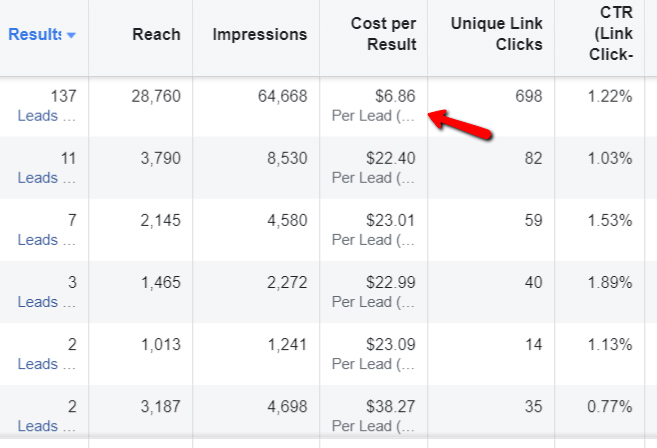
In Ice Cube Marketing, we have been building and collecting the data around business outcomes for the last 10 years. Find out the Cost per lead benchmarks for each industry in Singapore.
Mistake #6: Ignoring What Happens After the Lead Arrives
This is possibly the biggest hidden Facebook marketing problem.
The advertisement worked.
The prospect clicked.
The landing page worked.
The prospect enquired.
And then…
Nobody responds for three hours.
Marketing doesn’t end when the lead form is submitted.
Especially for SMEs selling services, the prospect may enquire with several businesses at roughly the same time.
Speed matters.
But blindly firing ten automated WhatsApp messages isn’t the solution either.
A better approach combines automation and human sales follow-up.
Automation can acknowledge the enquiry immediately, provide useful information, remind prospects about appointments and keep conversations moving.
Humans can then deal with questions, objections and closing.
This is why we increasingly get involved in SME’s lead management process in Singapore, rather than judging Facebook campaigns purely inside Ads Manager.
Advertising can generate demand.
Your sales process still has to capture it.
Mistake #7: Running the Same Creative Until It Dies
Singapore Digital Marketing advertisers have another structural problem:
Our market is small.
Even a good advertisement eventually becomes familiar.
The first time somebody sees an advertisement, they may notice it.
The fifth time, they recognise it.
The twentieth time, their brain may barely register that it exists.
This is commonly referred to as creative fatigue.
But refreshing your advertisements doesn’t simply mean changing the background colour from blue to red.
The bigger opportunity is refreshing the idea.
Instead of creating 20 visual variations of one message, test multiple marketing angles.
For example, the same service could be presented around:
- A painful problem
- A desired outcome
- A common objection
- A surprising fact
- A comparison
- A customer story
- A demonstration
This gives Meta genuinely different messages to match with different people.
With AI taking over more of the targeting work, creative strategy is becoming the new targeting.
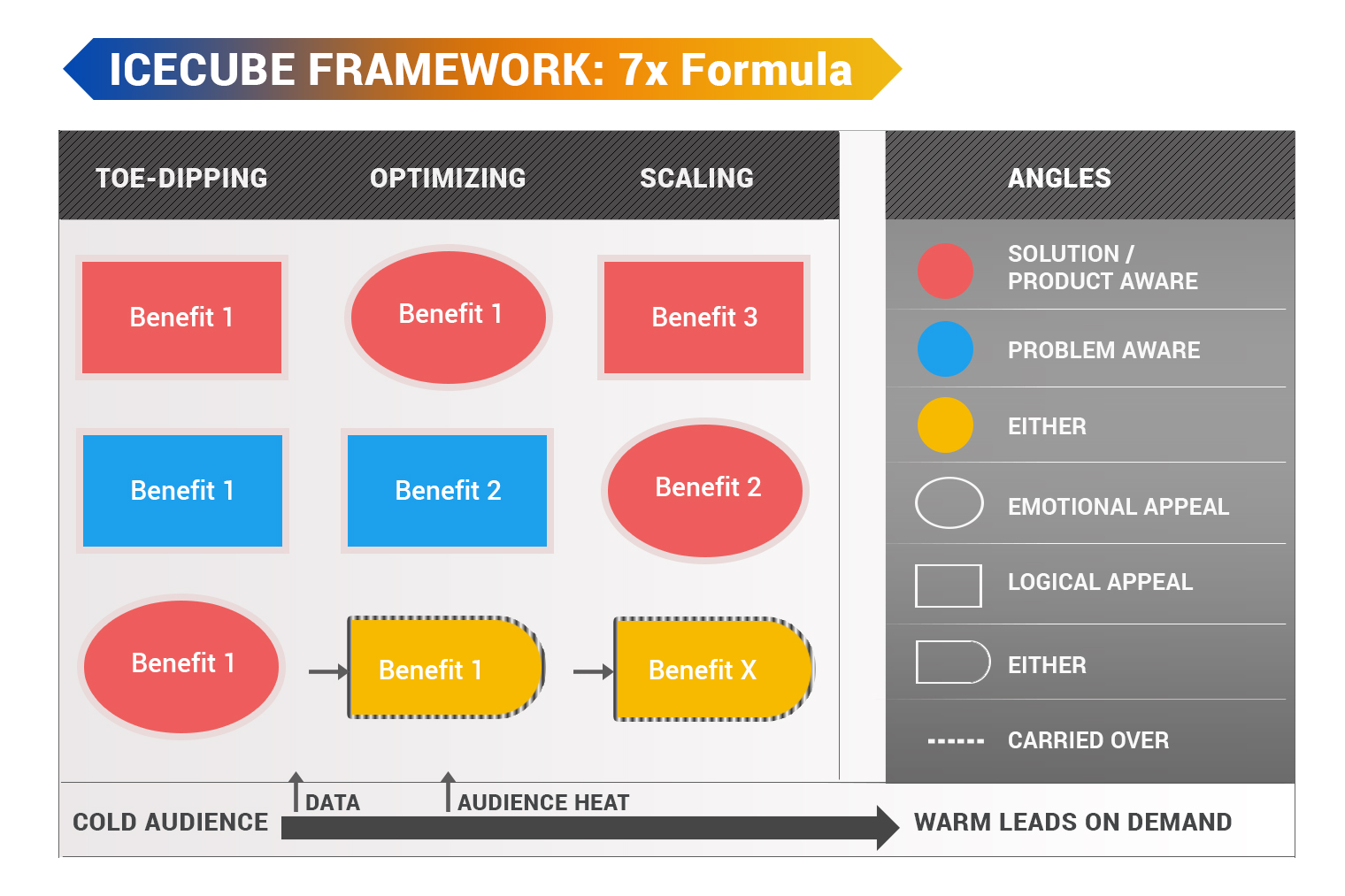
In a “Facebook X Icecube” live event we did with Facebook, we unveiled our unique framework for conceiving many new ad ideas easily! You can check out the recording here. It is known as the 7x formula. In a nutshell, you can create emotional, logical ads and problem-aware or solution-aware ads. You can easily conceive 10 new original ads by following the video in the link above. If you need an agency to do all the heavy lifting for you, don’t forget to check out our Facebook marketing services!
Mistake #8: Scaling Budget Without Understanding Why the Campaign Works
Your Facebook campaign generates leads at S$20 each.
Wonderful.
So you increase the budget dramatically and expect exactly the same S$20 CPL.
Unfortunately, advertising doesn’t work that way.
As Meta tries to spend more money, it must find additional opportunities to show your ads.
Those additional impressions may come from progressively more expensive auctions or prospects who are less likely to convert.
So instead of thinking:
“How much can I increase the budget?”
ask:
“At what cost per customer does this campaign remain profitable?”
Suppose a customer is worth S$2,000 in gross profit and your sales team closes one out of every ten qualified leads.
A S$30 lead may be fantastic.
A S$100 lead may still work.
A S$200 lead may not.
Your scaling ceiling should therefore be determined by unit economics, not an arbitrary Facebook advertising rule.
When performance starts deteriorating, don’t automatically create another ten ad sets.
First diagnose the actual bottleneck:
Is the creative fatigued?
Has conversion rate fallen?
Has lead quality changed?
Is the sales team converting fewer enquiries?
Are you reaching diminishing returns?
Or does the business simply need another acquisition channel?
Facebook is extremely powerful.
It doesn’t have to be your only channel.
Google Search, YouTube, SEO, email, WhatsApp and other channels can play different roles in the customer journey.
So, What Does Good Facebook Marketing Look Like in 2026?
The Facebook marketer’s job has changed.
Five years ago, much of the work revolved around operating Ads Manager.
Today, pressing the buttons is increasingly the easy part.
The competitive advantage is moving towards:
- Better customer insights.
- Better creative ideas.
- Better offers.
- Better conversion tracking.
- Better landing pages.
- Better follow-up.
- Better sales data.
Meta’s AI can decide which advertisement to show.
It cannot decide what makes your business genuinely worth choosing.
That is still marketing.
And that is where Singapore SMEs should be spending more of their effort.
Frequently Asked Questions About Facebook Marketing in Singapore
Is Facebook still worth advertising on in Singapore?
For many businesses, yes. Meta’s advertising data indicated potential Facebook ad reach of approximately 3.8 million people in Singapore in late 2025. Whether Facebook works for your business ultimately depends on your target market, offer, creative, funnel and economics rather than platform popularity alone.
How much do Facebook ads cost in Singapore?
There is no fixed Facebook advertising price because advertisers compete through an auction. Industry, audience, campaign objective, creative quality and competition all influence cost.
Based on Ice Cube Marketing’s 2026 dataset of 426 Singapore SME Meta accounts, average CPM was S$28.94 and average unique outbound CPC was S$3.07.
Should Singapore SMEs use Facebook or Instagram ads?
You often don’t need to choose between them. Both can be managed through Meta Ads Manager, and Meta can distribute campaigns across Facebook and Instagram placements based on expected performance.
Should I boost Facebook posts or use Ads Manager?
Businesses running performance campaigns should generally use Ads Manager because it provides substantially more control over objectives, tracking, audiences, creative testing and optimisation.
Boosting can have a role for simple distribution or engagement, but it shouldn’t be confused with a complete customer-acquisition strategy.
Should I hire a Facebook marketing agency?
An agency can make sense when the business lacks the internal time, expertise, creative resources or advertising volume required to test systematically.
But don’t evaluate an agency by how many Facebook posts it produces.
If your objective is customer acquisition, ask how the agency measures qualified leads, appointments, customers and ROI.
Final Thought
Facebook marketing isn’t dead.
Old Facebook marketing is.
The companies that struggle are often still trying to outsmart Meta’s algorithm by constantly changing targeting settings.
The businesses that succeed increasingly give the algorithm better ingredients:
Stronger messages. Better creative. Reliable conversion signals. Strong offers. And a sales process that turns enquiries into customers.
That is the Facebook marketing game Singapore businesses need to play in 2026.



6 Responses
Great read! Very insightful. Thanks!
Thanks Peter!
Hi..
I m a house agent.
I need help in FB marketing for my biz. I specialize in HDB resale in North area.
Will be able to assist?
Wats ur charges like?
Are u base in SG?
Are we able to tok on phone?
Henry Yap
Hp. 8777 2927
Hi Henry, Thanks for your enquiry. If you’re interested, please go through this page, https://icecube.asia/ to understand how we work and fill in the form & pre-intake survey if you would like to proceed. Thank you
this article was published more than a year ago… is it still relevant?
Yes its been updated