Based on 426 paid media projects and S$6million+ in total managed ad spend
Table of Contents
What is the average cost per lead in Singapore?
Most Singapore SME owners running paid ads have no idea whether their numbers are good or terrible. The average cost per lead in Singapore ranges from $17 to $250 depending on the industry.
A salon owner paying $40 a lead doesn’t know if that’s excellent or a disaster. A clinic converting 15% of enquiries into consults doesn’t know whether the problem is the ads, the offer, or the front desk. The agencies they ask have an obvious interest in the answer. The platform reps quote global averages that include markets forty times Singapore’s size.
So we published ours. This report aggregates paid media projects we’ve run across Singapore service businesses since 2015. Every figure is anonymised and reported at cohort level.
Definition of a lead
What we count as a lead. A contactable lead: a person who submitted valid contact details, de-duplicated, with spam and obvious junk removed. Not raw platform-reported conversions.
What we don’t count — and don’t run. None of the campaigns in this dataset used lucky draws, prize giveaways, or survey-style entry forms to manufacture signups. Every lead in these benchmarks came from a person who saw the actual product or service being advertised and put their details in because they were interested in it. They knew what they were signing up for.
This matters when you compare quotes. A lucky-draw or survey funnel will produce a cost per lead a fraction of the numbers in this report, and an agency can show you that number honestly. What it won’t show you is that most of those people entered for the prize and have no interest in what you sell — the cost simply moves downstream, into your sales team’s time and your telemarketer’s morale. If a proposal you’re weighing quotes a CPL well below our bottom quartile, the first question to ask is what the person was actually responding to.
Cost per lead by industry in Singapore (2026)
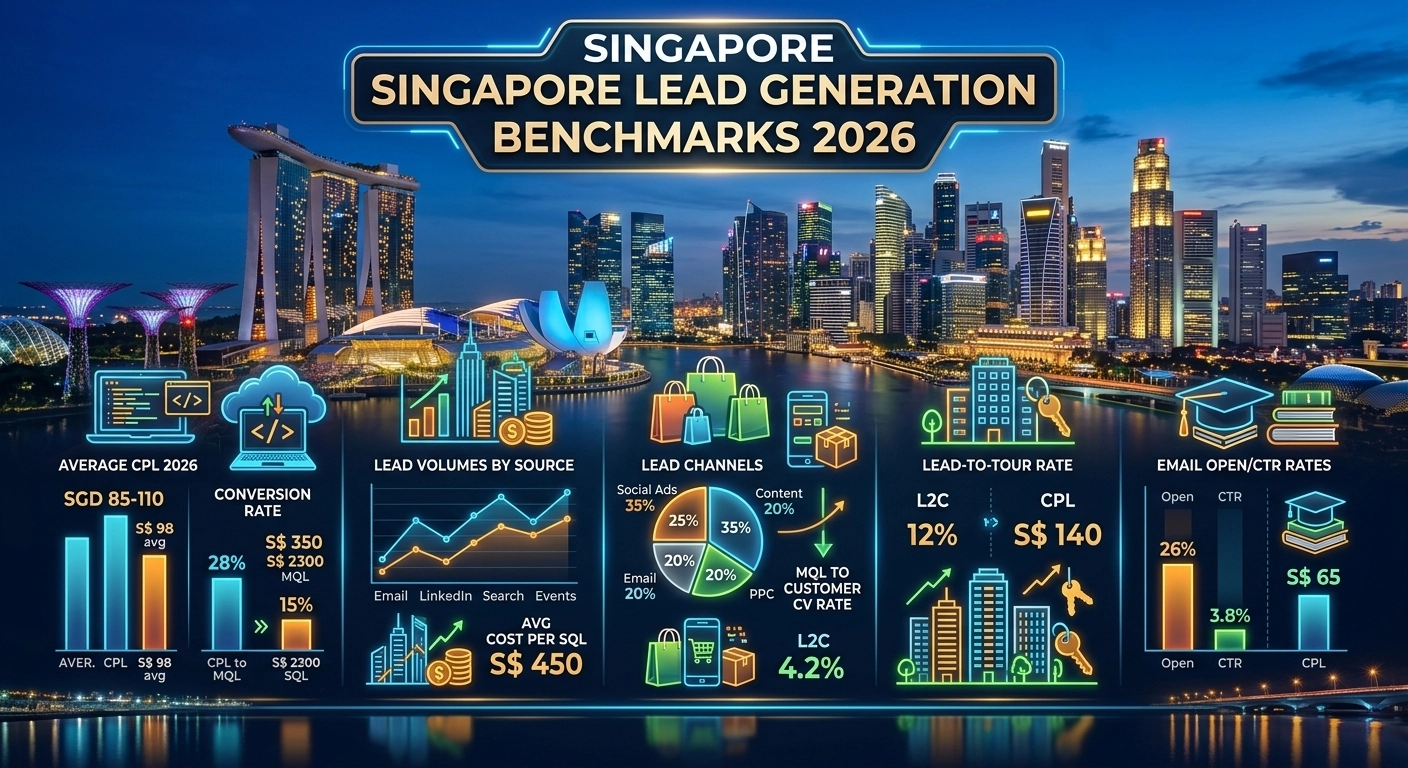
Singapore Lead Generation Benchmarks 2026 Cost per lead for each industry.
Based on 426 paid media projects and $6 million in annual managed ad spend.
| Industry | Cost per lead |
|---|---|
| Spa/massage | $25 – $50 |
| Maid agency | $30 – $70 |
| Aircon servicing | $17- $40 |
| Beauty (Facial) | $30- $55 |
| Beauty (Hair) | $25 – $50 |
| Beauty (Slimming) | $30 – $100 |
| Car rental | $28- $55 |
| Adult Coaching | $50- $100 |
| Fengshui | $30-$100 |
| Supplements | $30-$70 (per purchase) |
| Children enrichment | $30 – $100 |
| Gym | $30 – $70 |
| Healthcare | $20 – $70 |
| Swimming lessons | $30- $50 |
| Preschool | $150 – $250 |
| Tuition | $80 – $150 |
Across the paid advertising campaigns Ice Cube Marketing manages for Singapore service businesses, cost per lead ranges from $17 to $250 depending on the industry. Most local service businesses in Singapore fall between $25 and $100 per lead. Aircon servicing sits at the low end of the Singapore market at $17 to $40 per lead, while preschool enrolment is the most expensive at $150 to $250 per lead.
How to calculate ROAS from cost per lead
Cost per lead on its own tells you nothing about whether a campaign makes money. To know that, you need three more numbers: how many leads turn into appointments, how many appointments turn into customers, and what a customer is worth.
A note on where these figures come from: Unlike the benchmark tables above, the ranges in this section are not extracted from our full dataset — we don’t hold appointment and closing data consistently enough across eight years to publish it as a benchmark. These are the working ranges we see in live accounts in these two categories, and we’re showing them as a model so you can substitute your own numbers. Treat the method as the deliverable, not the outputs.
Example 1 — Beauty salon / aesthetics
| Variable | Range |
|---|---|
| Cost per lead | $30 – $50 |
| Lead → appointment | 40% – 60% |
| Appointment → sale | 20% – 30% |
| Package value | $1,000 – $3,000 |
| Scenario | Cost per appointment | Cost per customer | Revenue per customer | ROAS |
|---|---|---|---|---|
| Strong execution | $50 | $167 | $3,000 | 18.0x |
| Mid-case | $80 | $320 | $2,000 | $6.3x |
| Weak execution | $125 | $625 | $1,000 | 1.6x |
The cost per lead moved by less than 2x across those three scenarios. The return moved by more than 11x. Media buying accounted for almost none of that difference.
Example 2 — Curtains / soft furnishings
| Variable | Range |
|---|---|
| Cost per lead | $40 – $60 |
| Lead → appointment | 60% – 80% |
| Appointment → sale | 20% – 30% |
| Package value | $1,000 – $3,000 |
| Scenario | Cost per appointment | Cost per customer | Revenue per customer | ROAS |
|---|---|---|---|---|
| Strong execution | $50 | $167 | $3,000 | 18.0x |
| Mid-case | $71 | $286 | $2,000 | $7.0x |
| Weak execution | $100 | $500 | $1,000 | 2.0x |
Read those two tables side by side
Curtains leads cost roughly 33% more than beauty leads. Curtains businesses nonetheless model to a better mid-case return, because their appointment rate is 20 percentage points higher.
That is the entire argument of this report in one comparison. The more expensive lead was the cheaper customer. Any decision made on cost per lead alone would have picked the wrong one.
Why the home visit appointment rate is higher
- Site visit or home appointment — you travel to them
- Zoom or video consultation — nobody travels
- Phone consultation with a scheduled slot
- In-person visit to your premises — they travel to you
What affects appointment rate
Convenience is the structural one. Four more are operational, and all of them sit inside your business rather than inside the ad account:- Speed of follow-up. Interest decays fast. A lead contacted while the ad is still on their screen is a different prospect from the same lead contacted the next morning.
- Frequency and quality of reminders. No-shows are largely a reminder-sequence problem, not a lead-quality problem.
- Telemarketer sales skill. The single widest source of variance we see between two clients running near-identical campaigns. Same leads, same cost, different person on the phone, materially different appointment rate.
- Number of contact attempts before giving up. Most teams stop after two. The leads sitting in attempts three through six were paid for at the same price as the rest.
What factors affect cost per lead?
When your CPL sits outside your industry’s range, it’s almost always one of these — roughly in order of how much they move the number:
| Factor | What it does |
|---|---|
| Offer | The single biggest lever. What the prospect gets, and what you ask for in return. A strong, specific, time-bound offer can halve CPL without touching targeting. |
| Brand recognition | A name people already know converts colder traffic. Established brands in our sample consistently sit in the better quartile on identical creative strategies. |
| Credentials and accreditation | Licences, awards, certifications, years in business, doctor or specialist credentials. These reduce the perceived risk of handing over a phone number. |
| Social proof | Volume and visibility of reviews, testimonials, before-and-afters, recognisable clients. Weak proof is a CPL tax you pay on every click. |
| USP and product uniqueness | If your offer is functionally identical to four competitors bidding the same auction, you compete on price of attention alone — the worst position to be in. Genuine differentiation is a media cost saving. |
| Campaign type | Native lead forms typically produce cheaper, lower-intent leads; landing pages typically produce dearer, higher-intent ones; click-to-WhatsApp sits in between and behaves differently again. This is a deliberate trade, not an optimisation. |
| Creative volume and refresh rate | Small market, high frequency. Creative fatigue arrives faster in Singapore than the global benchmarks assume. |
| Competitive intensity in the vertical | Auction pressure varies enormously by category and by season. |
| Budget level | Very small budgets never exit the learning phase cleanly; very large ones push into weaker audience segments. Both raise CPL, for opposite reasons. |
Find your leak: a five-question diagnostic
| If... | Then the problem is... |
|---|---|
| CPL is above bottom-quartile for your industry | Offer or creative — not budget |
| CPL is at or below median but volume is too low | Audience size or budget ceiling, not efficiency |
| CPL is fine, but few leads become appointments | Follow-up speed, contact persistence, and how convenient the appointment is for them |
| Appointments get booked but not attended | Reminder sequence and appointment friction |
| All of the above are fine but revenue isn’t | Sales closing skill, Pricing, or the offer attracts the wrong buyer |
Frequently asked Questions
Have you ever beaten these benchmarks?
Yes. The benchmarks describe what’s normal, not what’s possible, and there are real exceptions. The accounts that consistently outperform their category’s best quartile tend to have at least one of the following, and usually several:
What these have in common is that none of them are media buying. They’re reasons a prospect is willing to raise their hand faster, and they show up as a lower cost per lead.
Then can you get me below the benchmark?
Not by promising it. If your business already has those advantages, the numbers usually follow. If it doesn’t, the honest path is to build one of them — and in the meantime, plan on the median for your category rather than the exception.
Why is my current agency quoting a much lower CPL?
Check the definition first (see “How to read this report”). The three most common explanations are raw form fills counted as leads, lucky-draw or survey mechanics, and a much softer offer — all of which produce a genuinely lower number and a genuinely worse outcome.
Is a higher cost per lead ever a good sign?
Often. Higher-intent campaign types and harder qualifying questions both raise CPL and raise close rate. The worked examples show why the two can’t be judged separately.
Methodology
These figures are drawn from paid advertising campaigns managed by Ice Cube Marketing, a Google Premier Partner and PSG pre-approved vendor based in Singapore, for Singapore-based service businesses. Ranges are indicative of typical account performance in 2026 and are stated per contactable lead unless otherwise noted. Ice Cube Marketing does not publish appointment or closing rates by industry, as those sit inside client sales operations and are not tracked to a consistent standard across accounts.
Citation: Ice Cube Marketing, Cost Per Lead by Industry in Singapore (2026). Reproduction permitted with attribution and a link to the source page.